“Doctorate” sounds like one thing. In practice the word covers degrees that differ a lot in purpose, level, workload and in what employers make of them. If you are weighing a classic PhD against a professional doctorate such as a DBA, or against the Slovak PhDr., it helps to set the three side by side before you look at prices or start dates.
This article does exactly that. It is written by a provider of the PhDr. program, so we will be clear about where the PhDr. fits and where it does not.
Three degrees, three purposes
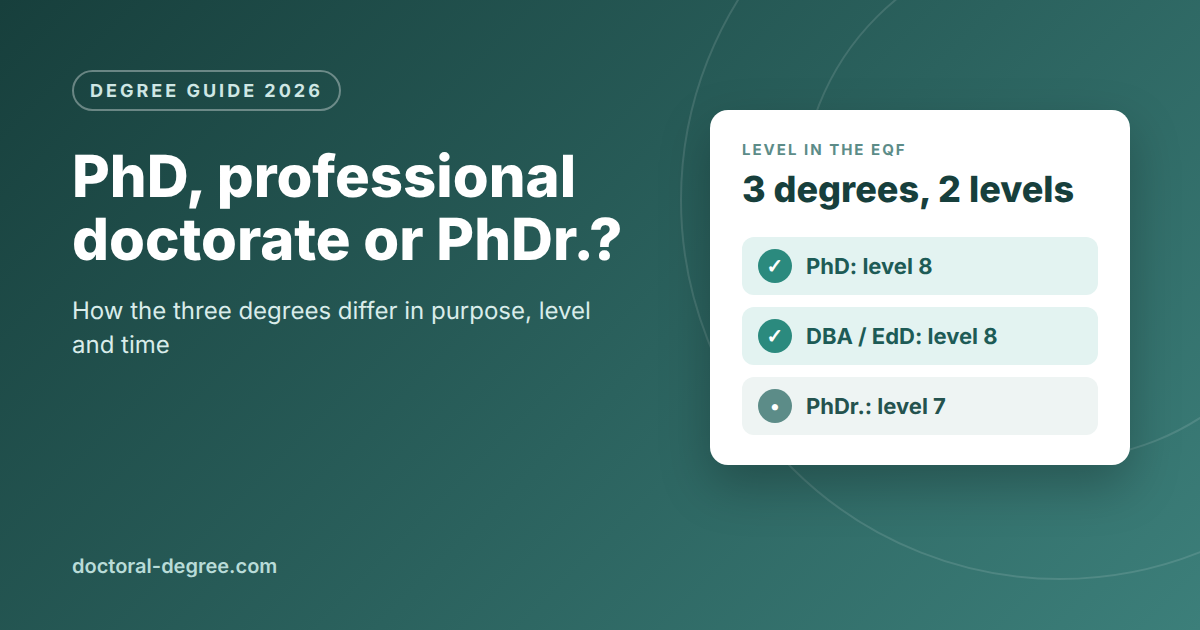
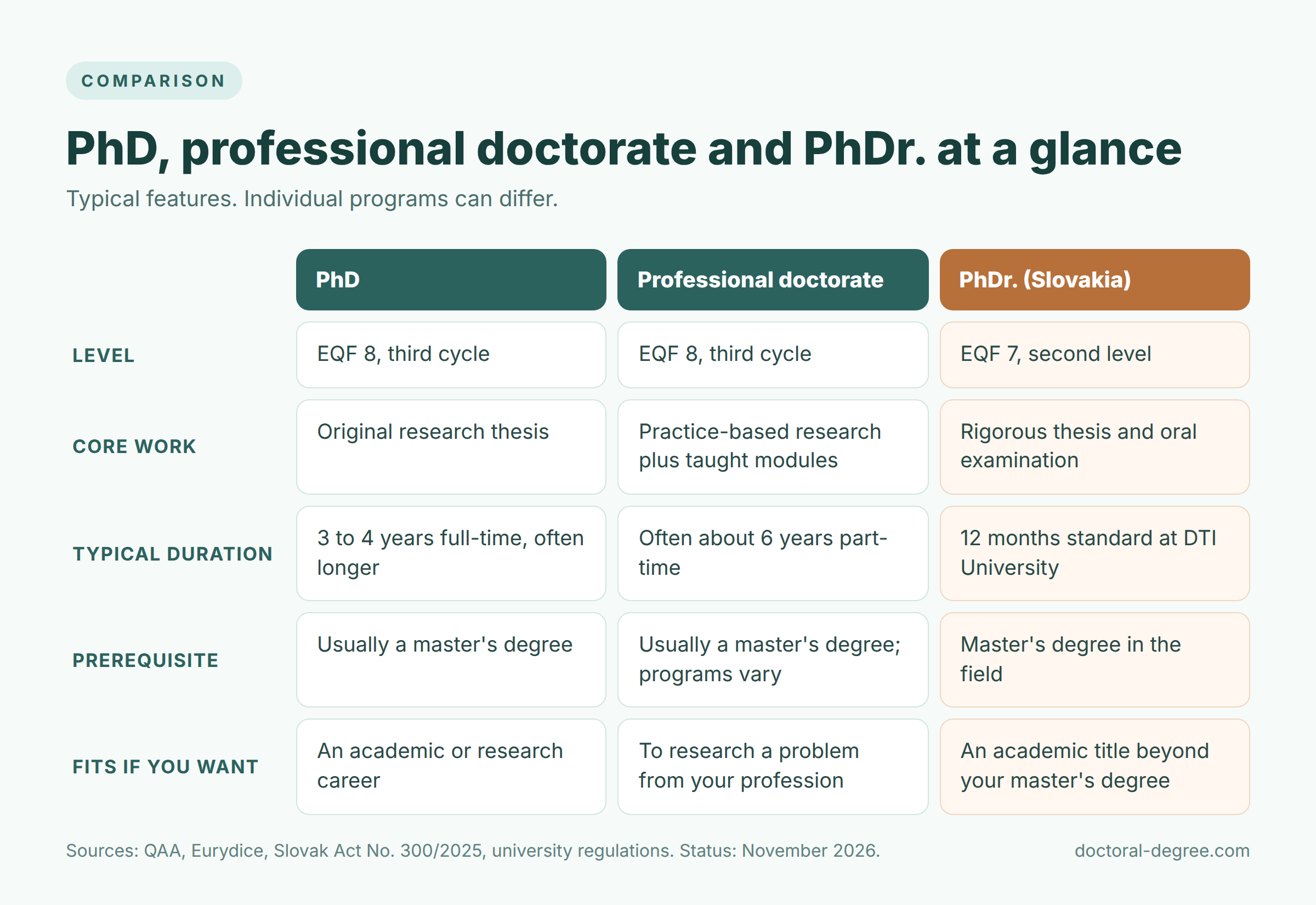
The short answer: a PhD trains you as a researcher, a professional doctorate applies research to your field of practice, and the PhDr. is an academic title for master’s graduates that rests on an independent thesis and an oral examination.
The PhD: a research degree
The PhD is the standard third-cycle degree in Europe, placed at level 8 of the European Qualifications Framework. Its core is original research. The UK Quality Assurance Agency puts it plainly in its Doctoral Degree Characteristics Statement: whatever the form, every doctoral graduate has made an original contribution to knowledge in their subject, field or profession.
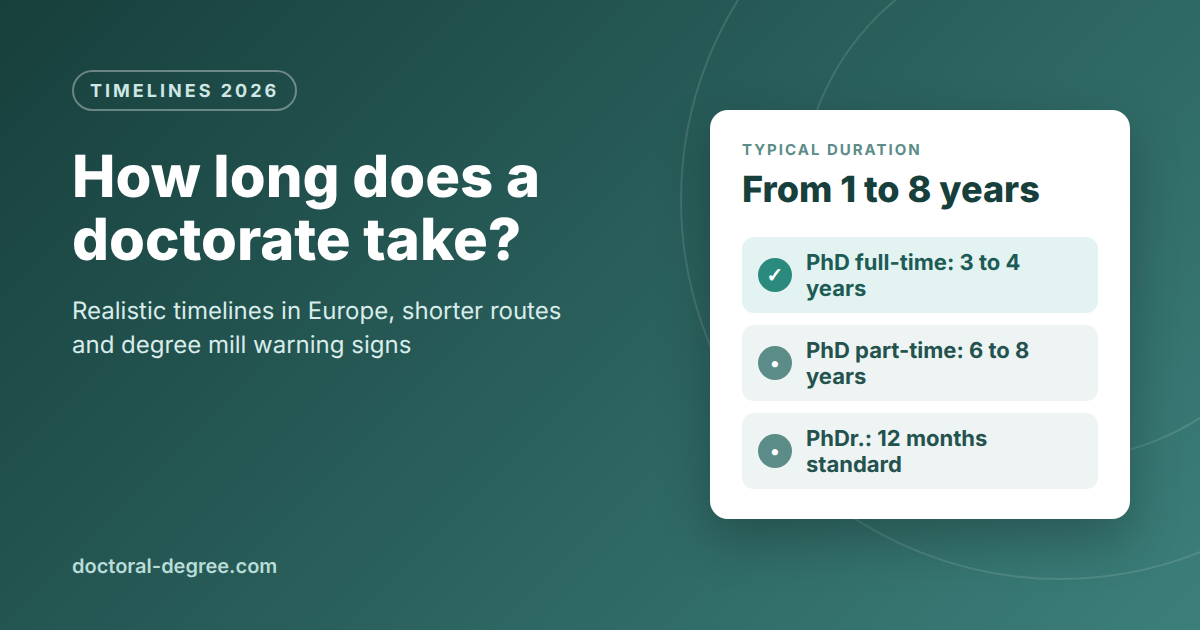
That takes time. The Salzburg Principles, agreed by European universities in 2005, set a duration of three to four years of full-time study as the rule (summarized by the European Students’ Union). Reality often runs longer. In a 2019 survey by the European University Association, only about half of the responding universities said that their doctoral graduates typically finished within that window, and more than a quarter reported average completion times of five years or more (Times Higher Education).
A PhD makes sense if you want an academic career, a research position in industry, or if you simply want to spend several years on one question.
Professional doctorates: research for practitioners
Professional doctorates such as the Doctor of Business Administration (DBA) or the Doctor of Education (EdD) sit at the same level as the PhD. The difference is the focus. The research is tied to professional practice, it is often carried out in the candidate’s own organization, and most programs include taught elements alongside the thesis. QAA describes this shift in the UK since the 1990s, beginning with the EdD.
These programs are usually designed for people in work, which also means they take a while. The University of Sheffield, for example, lists a normal period of six years for its part-time EdD (registration periods).
The PhDr.: an academic title at master’s level
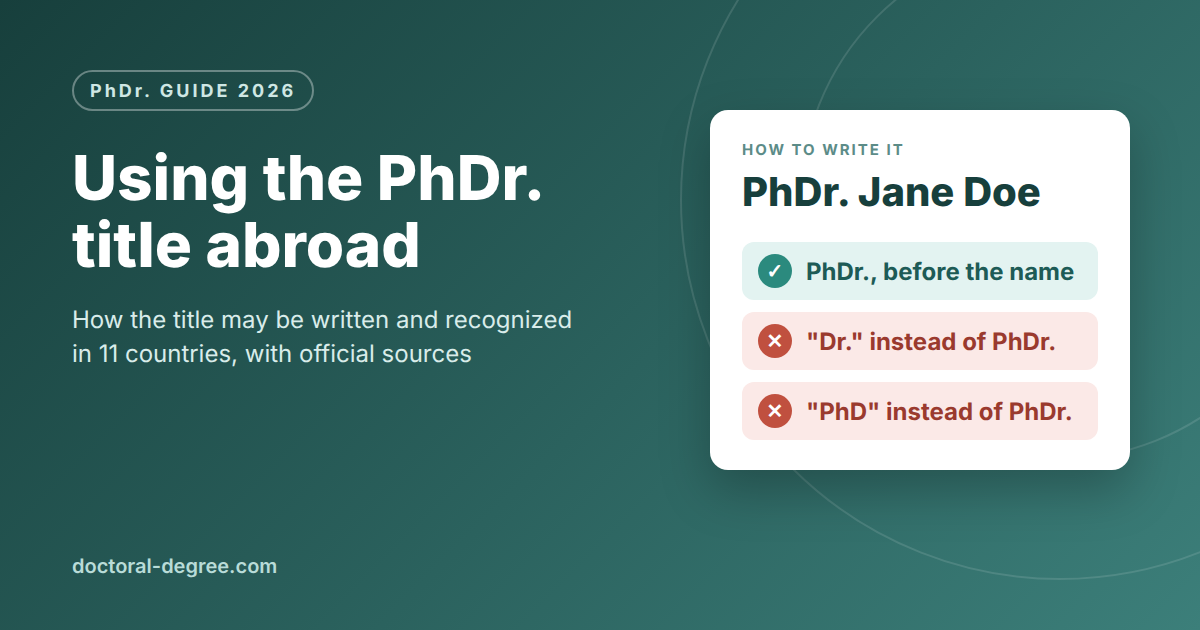
The PhDr. (doktor filozofie) comes from the Czech and Slovak tradition. Under section 61 of the Slovak Higher Education Act (Act No. 300/2025 Coll.), holders of a master’s degree may take a rigorous examination that includes the defense of a rigorous thesis. After passing, they receive the title, written before the name.
The important point is the level. Slovakia places the rigorous titles at the second level of higher education, EQF level 7, while the PhD is a third-level degree (Eurydice). The PhDr. is therefore not a shortened PhD. It is an additional academic qualification for people who already hold a master’s degree and want to show independent academic work beyond it.
At DTI University the program runs without lectures. You write a thesis of 90 to 120 pages in English, it is checked for plagiarism and reviewed by two independent reviewers, and you defend it before an examination board by video conference. The standard period is 12 months. Details are on our procedure page.
Which degree fits which goal?
- You want to teach and research at a university: a PhD. Academic appointments usually ask for one, and a PhDr. does not replace it.
- You lead people or projects and want to investigate a real problem from your field in depth: a professional doctorate such as a DBA, if you can invest several years.
- You hold a master’s degree, want a recognized academic title on top of it and can work independently: the PhDr. can be a good fit, especially in Central Europe where these titles are familiar.
- You need the word “doctorate” for a regulated purpose, such as a professorship, a license or a public salary scale: check the exact requirement first. Because the PhDr. is classified at master’s level, it may not count as a doctorate for such purposes.
Questions to ask any provider
- At which EQF level is the degree classified in the awarding country?
- What is the legal basis, and which university awards the title?
- How is the thesis assessed, and is there an oral defense before a board?
- How may I write the title in my country? Our guide Using the PhDr. title abroad covers eleven countries.
- What does the program cost in total, and what happens if I need more time?
A provider who answers these questions in writing and links to official sources is usually a provider you can work with. One who avoids them is not. If you want to know whether the PhDr. fits your plans, book a free consultation via the contact page.
Written by Oliver Scharfenberg, PhDr. MBA. Transparency note: this website is operated by Syntharis Group. Syntharis Group advises applicants, places them with DTI University and provides the translations needed for the procedure, so we have a commercial interest in the PhDr. program. Facts about other degrees are taken from the sources linked above.

Related Posts