Search for “fastest doctorate” and you will find offers promising a doctoral title in a few months. Some of them are legitimate programs with an honest description of what you get. Others sell paper. The way to tell them apart is to know how long the different routes to a doctor title really take and why.
This guide lays out realistic timelines for the main routes in Europe, explains where shorter paths legitimately exist, and lists the warning signs that should make you walk away.
The benchmark: three to four years for a PhD
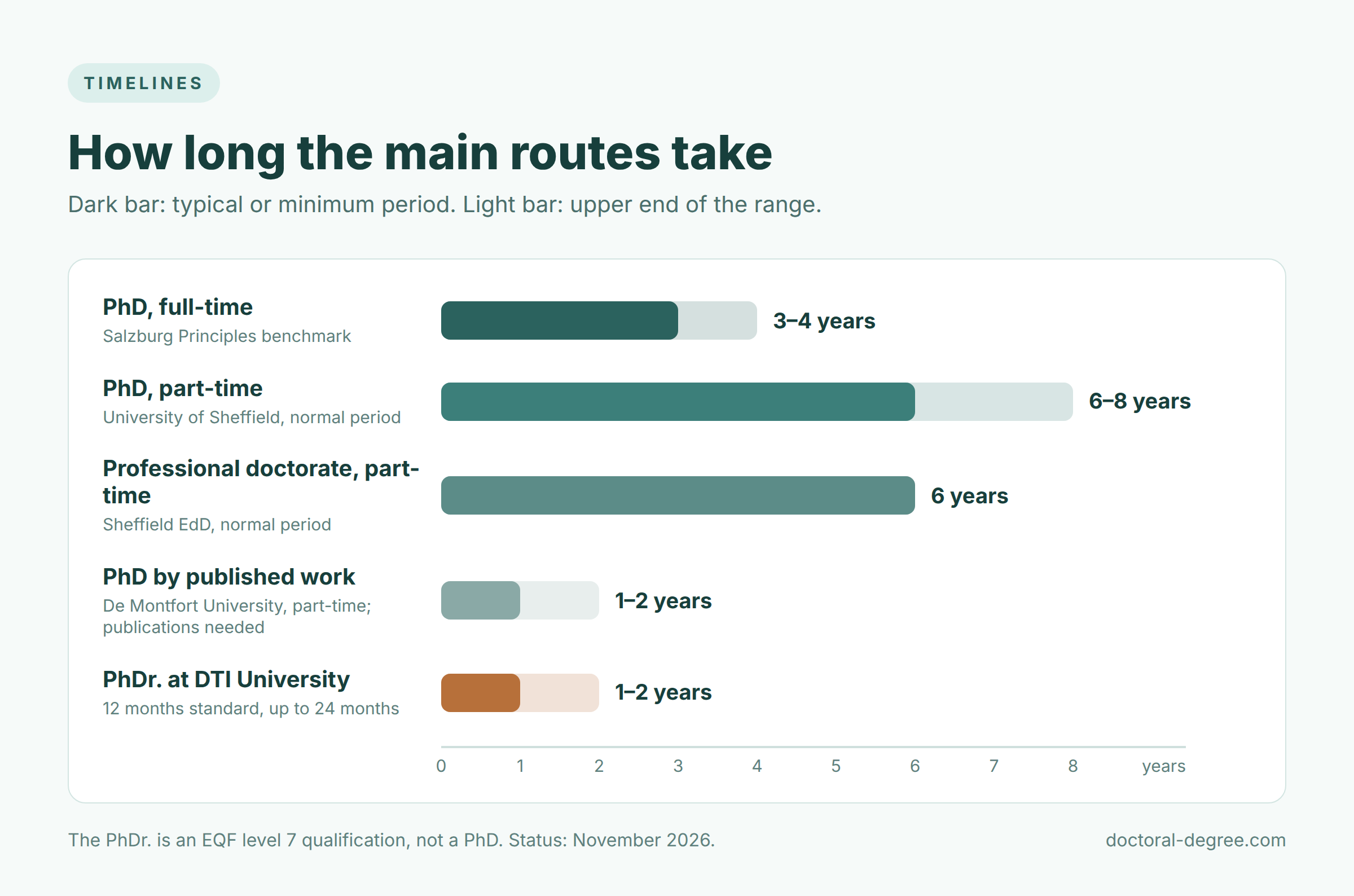
European universities agreed in the Salzburg Principles of 2005 that doctoral programs should normally take three to four years of full-time study (summarized by the European Students’ Union). National rules follow that pattern. Slovakia offers three- and four-year PhD programs (Eurydice Slovakia), and in Austria a doctoral program must last at least three years (Eurydice Austria).
In practice many candidates need longer. When the European University Association surveyed universities in 2019, only 51 percent said their doctoral graduates typically finished within three to four years, and more than a quarter reported average completion times of five years or more (Times Higher Education).
Part-time study stretches the timeline further. The University of Sheffield, to take one published example, gives a normal period of six to eight years for a part-time PhD and six years for its part-time Doctor of Education (registration periods).
Legitimate routes that take less time
PhD by published work
Several UK universities award a PhD on the basis of research you have already published, together with a critical commentary and an oral examination. Registration periods are short. De Montfort University, for example, sets a minimum of one year and a maximum of two years of part-time registration for its PhD by Published Works (registration periods, PDF). The catch: the research has already happened. Most of the years are simply behind you, in the form of peer-reviewed publications.
The rigorous procedure (PhDr.)
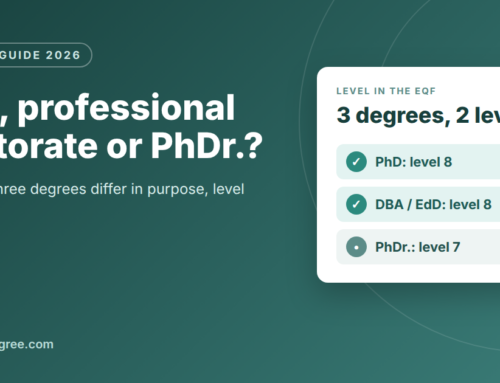
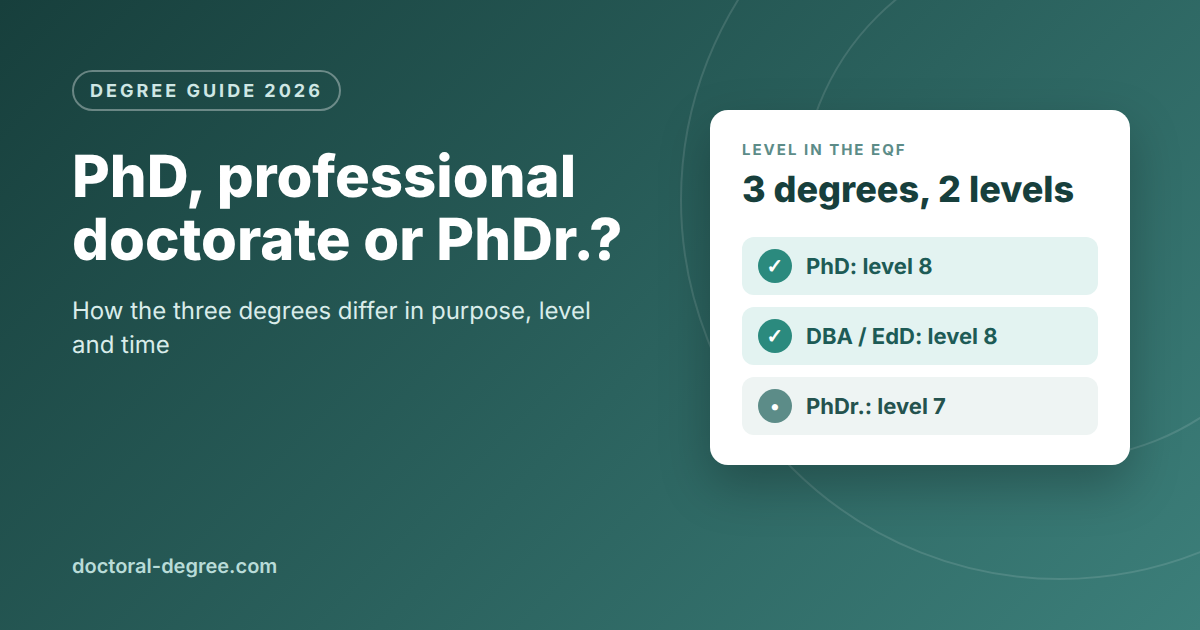
In Slovakia, and similarly in the Czech Republic, master’s graduates can take a rigorous examination with the defense of a rigorous thesis and receive a title such as PhDr. The legal basis in Slovakia is section 61 of Act No. 300/2025 Coll. The procedure is shorter than a PhD because it is a different qualification: it builds on the master’s degree and sits at the same level, EQF 7, not at the doctoral level 8.
At DTI University the standard period is 12 months, with a free extension up to 24 months. You write a thesis of 90 to 120 pages, it goes through a plagiarism check and two independent reviews, and you defend it before an examination board. That is a real workload, but it is not a PhD, and nobody should sell it as one. We explain the differences in Dr., PhDr., PhD: comparison of doctoral degrees.
Recognition of earlier work
The new Slovak act also allows a university to accept a defended diploma or dissertation thesis as the rigorous thesis, under its internal rules. Whether this applies to you depends entirely on the university and your previous work, so treat it as a question to ask, not as a promise.
Warning signs of a degree mill
The Council for Higher Education Accreditation (CHEA) and UNESCO published a joint statement on degree mills that lists typical features (CHEA/UNESCO statement, PDF). Among them:
- money alone is enough to get the credential, without real academic work,
- false or exaggerated claims about accreditation or quality review,
- degrees that are not accepted for further study or licensing even in the provider’s own country,
- no verifiable list of academic staff and their qualifications,
- websites whose domain owner is hidden behind a privacy service.
Add a few practical checks of your own. Look up the awarding university in the official register of its country; for Slovakia that is the Portal of Slovak universities. Ask for the legal basis of the title and its EQF level. Ask how the thesis is examined and whether there is an oral defense. If the answers are vague, you have your answer. Our article on buying a doctorate explains why shortcuts of that kind end badly.
How to pick a realistic timeline for yourself
- Define the goal first. An academic career needs a PhD, whatever it takes. A title that documents academic work beyond your master’s degree can come from a shorter procedure.
- Count your hours, not your months. Twelve months of evenings is not the same as twelve months full-time.
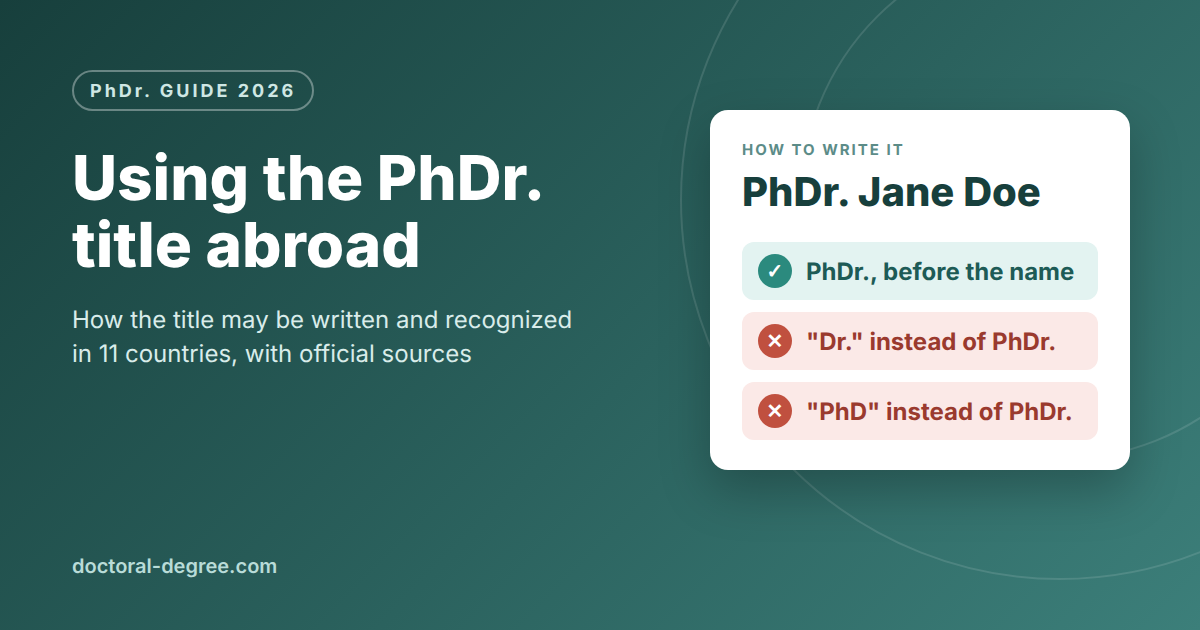
- Check what the title will be worth where you live. See our guide Using the PhDr. title abroad.
- Plan a buffer. Even short procedures depend on reviews and examination dates that you do not control.
Written by Oliver Scharfenberg, PhDr. MBA. Transparency note: this website is operated by Syntharis Group. Syntharis Group advises applicants, places them with DTI University and provides the translations needed for the procedure, so we have a commercial interest in the PhDr. program. Facts about other degrees are taken from the sources linked above.

Related Posts