A PhDr. from a Slovak university is a real academic title, awarded under Slovak law. What it is not is a universal key that opens the same doors everywhere. Each country decides for itself how a foreign title may be written, whether it has to be recognized first and in which situations it may not be used at all. This guide collects the rules for the countries our students ask about most, with links to the official sources so you can check the details yourself.
One remark before we start: this is general information, not legal advice. Rules change, and when a job, a license or a public office depends on your title, ask the competent authority in that country for a binding answer.
The short version
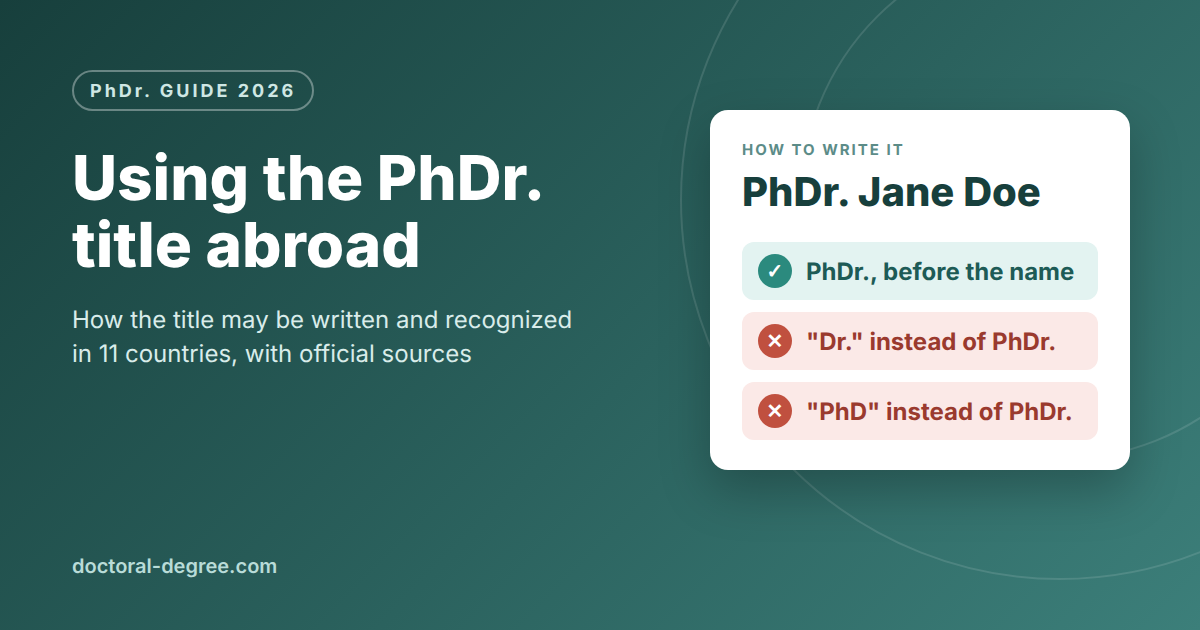
- Use the original form. The title is “PhDr.” and it is written before your name. Converting it into “Dr.” or “PhD” is not allowed in most countries and is expressly excluded in Germany.
- Using a title and having a degree recognized are two different things. Many countries let you carry a foreign title in its original form, but a public employer, a university or a professional body may still ask for a formal recognition or a comparability statement.
- Regulated professions follow their own rules. In health care, law or teaching, the right to call yourself “doctor” is often tied to a professional license, not to an academic degree.
What the PhDr. is under Slovak law
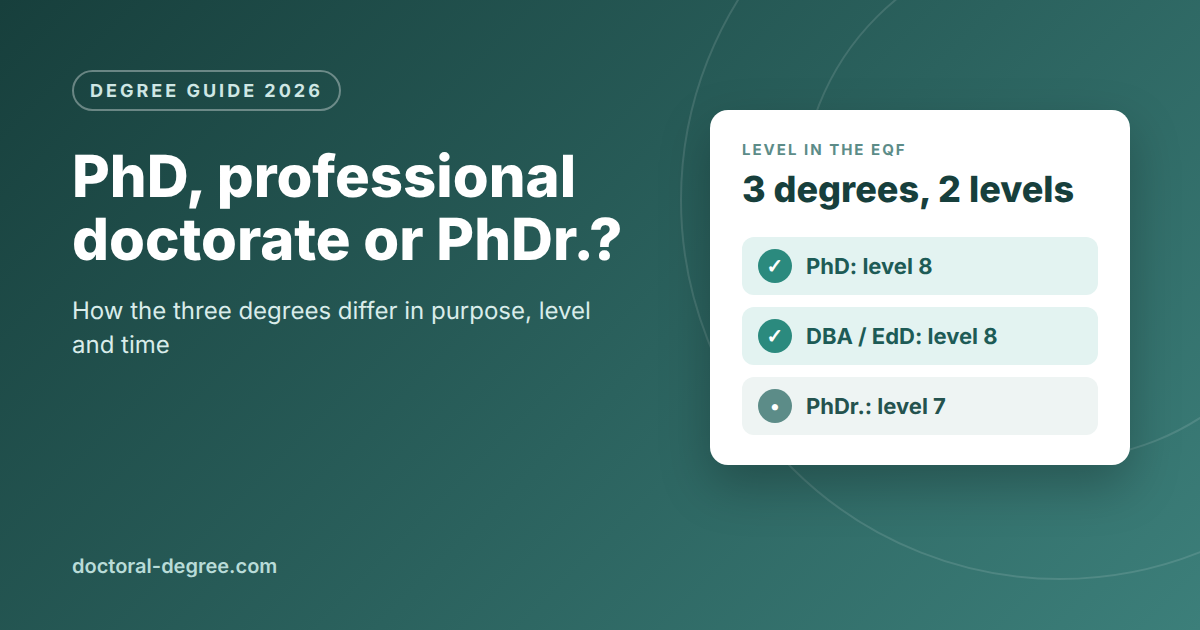
Since 1 September 2026 the rigorous procedure is governed by the Slovak Higher Education Act, Act No. 300/2025 Coll. Section 61 allows holders of a master’s degree to take a rigorous examination with the defense of a rigorous thesis, after which the university awards a title such as doktor filozofie (PhDr.). Slovakia places these titles at the second level of higher education, which corresponds to level 7 of the European Qualifications Framework, while the PhD is a third-level degree at level 8 (Eurydice).
That classification matters abroad. Recognition offices look at the level of a qualification, not at the word “doctor” in its name. Expect the PhDr. to be treated as an advanced qualification at master’s level, not as a research doctorate. If you want the background, read our comparison Dr., PhDr., PhD: how the titles differ.
Czech Republic
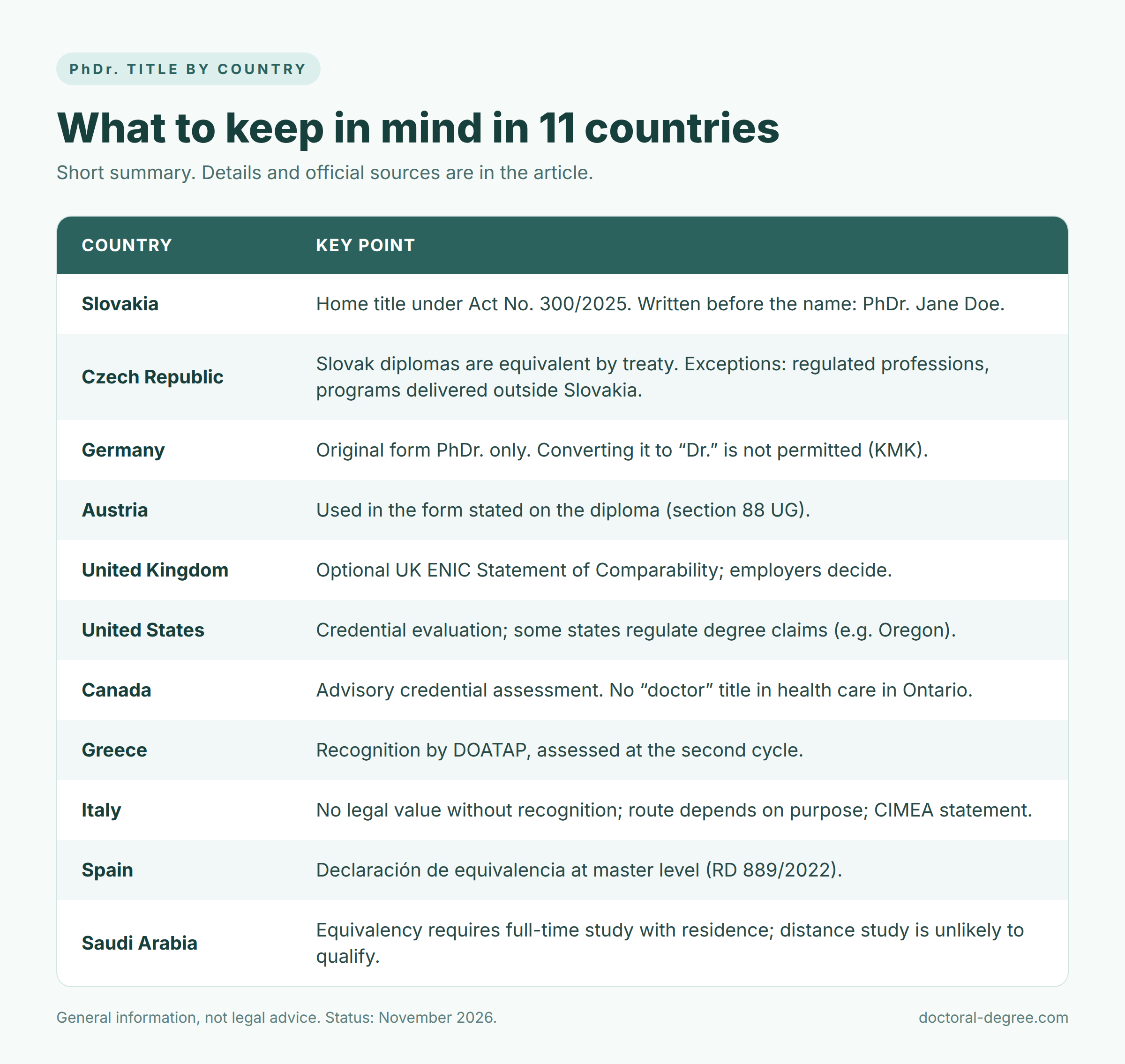
The Czech Republic and Slovakia have a treaty on the mutual recognition of educational documents. Under it, Slovak higher education diplomas are recognized as equivalent in the Czech Republic without a recognition procedure, and the PhDr. exists in both systems under the same name (Masaryk University overview). Two exceptions apply: regulated professions, and Slovak programs that were delivered outside Slovak territory. For the latter, Czech universities ask for a recognition procedure.
Germany
In Germany, foreign degrees may be used under the higher education laws of the federal states, which follow common principles agreed by the Standing Conference of Education Ministers (KMK). Doctoral degrees from EU countries may normally also be written as “Dr.” without further additions. The KMK agreement excludes doctoral titles that the home country does not place at the third Bologna level, and the explanatory notes name the Slovak “small doctorates” such as PhDr. as an example (KMK agreement, version of 20 November 2025).
In practice: write “PhDr. Jane Doe”, never “Dr. Jane Doe”. Using an academic title you are not entitled to is an offence under section 132a of the German Criminal Code, so this is not a detail to be relaxed about.
Austria
Austria’s University Act (section 88 UG) gives anyone who received an academic degree from a recognized domestic or foreign post-secondary institution the right to use it in the form stated in the award certificate, including the abbreviated form. Holders of degrees from EU and EEA countries may also ask for the abbreviation to be entered in public documents such as a passport (section 88 UG). For a Slovak PhDr. that means: “PhDr.” as written on your diploma. A memorandum between the Austrian and Slovak education ministers adds that academic degrees of either country should be usable in the other in their original form (OeAD summary, PDF in German).
United Kingdom
The UK has no procedure that “converts” a foreign title. What exists is a Statement of Comparability from UK ENIC, the national agency for international qualifications. It explains how a foreign qualification compares with UK qualifications and framework levels and is used for jobs, further study or professional registration. UK ENIC stresses that the statement supports your qualification and does not replace it (UK ENIC). Employers decide for themselves how much weight they give it.
United States
There is no federal ministry that recognizes foreign degrees. Employers and universities usually rely on credential evaluations from private evaluation services. A few states regulate how degrees may be claimed. Oregon is the best-known example: its Office of Degree Authorization validates degree claims and acts against substandard and fraudulent degrees, and state law, with some exceptions, ties degree claims to accreditation recognized by the US Department of Education or a foreign equivalent (Oregon HECC). If you live in the US, check your own state’s rules and present the title together with an evaluation that states its level.
Canada
Recognition in Canada is decentralized. Credential assessments from the organizations listed by the Canadian Information Centre for International Credentials (CICIC) are advisory; for occupations that are not regulated, the employer decides. The title “doctor” itself is restricted in health care. In Ontario, section 33 of the Regulated Health Professions Act prohibits using “doctor”, a variation, an abbreviation or an equivalent in another language while providing or offering health care, with exceptions for five professions such as physicians and psychologists (Ontario e-Laws). Outside clinical settings the rule does not apply, but if you work in a health-related field, keep the PhDr. strictly separate from patient contact.
Greece
Foreign degrees are recognized in Greece by the Hellenic NARIC, DOATAP, which assesses them by cycle. Because the PhDr. is a second-cycle qualification, an application would be assessed at that level and not as a doctorate.
Italy
In Italy a foreign qualification has no legal value on its own. Depending on the purpose, it is recognized by a university (for academic purposes), by the administration you are dealing with (for example in a public competition), or it is accompanied by a statement of comparability from CIMEA, the Italian ENIC-NARIC center. Find out which route the office in question accepts before you apply.
Spain
Spain regulates the recognition of foreign university qualifications in Royal Decree 889/2022. There are separate procedures: homologación for access to a regulated profession, and the declaración de equivalencia, which recognizes a foreign degree at the level of a Grado or Máster with purely academic and administrative effects (Spanish ministry). Doctoral-level qualifications follow a separate procedure. As a second-cycle title, a PhDr. would fall under the equivalence at master’s level.
Saudi Arabia
We say this openly because it saves people disappointment. The Saudi Ministry of Education’s equivalency rules require, as a principle, regular and full-time study with residence in the country of study, and prior approval to study abroad does not oblige the ministry to grant equivalency afterwards (Ministry of Education). A distance program without residence in Slovakia is therefore unlikely to receive equivalency. If you need the title for a Saudi employer that requires equivalency, discuss this with us before you register.
A checklist before you put “PhDr.” on your business card
- Write the title exactly as it appears on your diploma and place it before your name.
- Do not translate it into “Dr.” or “PhD”, and do not combine it with a country abbreviation unless the local rules ask for one.
- Find out whether your employer or authority needs a formal recognition or a comparability statement, and for which purpose.
- If you work in a regulated profession, check with your professional body before using any “doctor” title in your work.
- Keep a certified copy of your diploma and, where available, the diploma supplement ready. Many offices ask for both.
Rules for other countries can be added on request. If yours is not listed, write to us via the contact page and we will look at it in your consultation. More on how the program itself works is on the procedure page.
Written by Oliver Scharfenberg, PhDr. MBA. Transparency note: this website is operated by Syntharis Group. Syntharis Group advises applicants, places them with DTI University and provides the translations needed for the procedure, so we have a commercial interest in the PhDr. program. The rules described above are taken from the official sources linked in each section.

Related Posts