Most people who ask us about a doctorate already have a full-time job, often a family, and no plan to give up either. The good news is that several routes to a doctor title are designed for exactly that situation. The less comfortable news is that all of them cost time, and the differences in time are larger than most brochures admit.
Below you will find the main options for working professionals, what universities expect in hours per week, and a few things to sort out with your employer before you start.
Start with your weekly hours
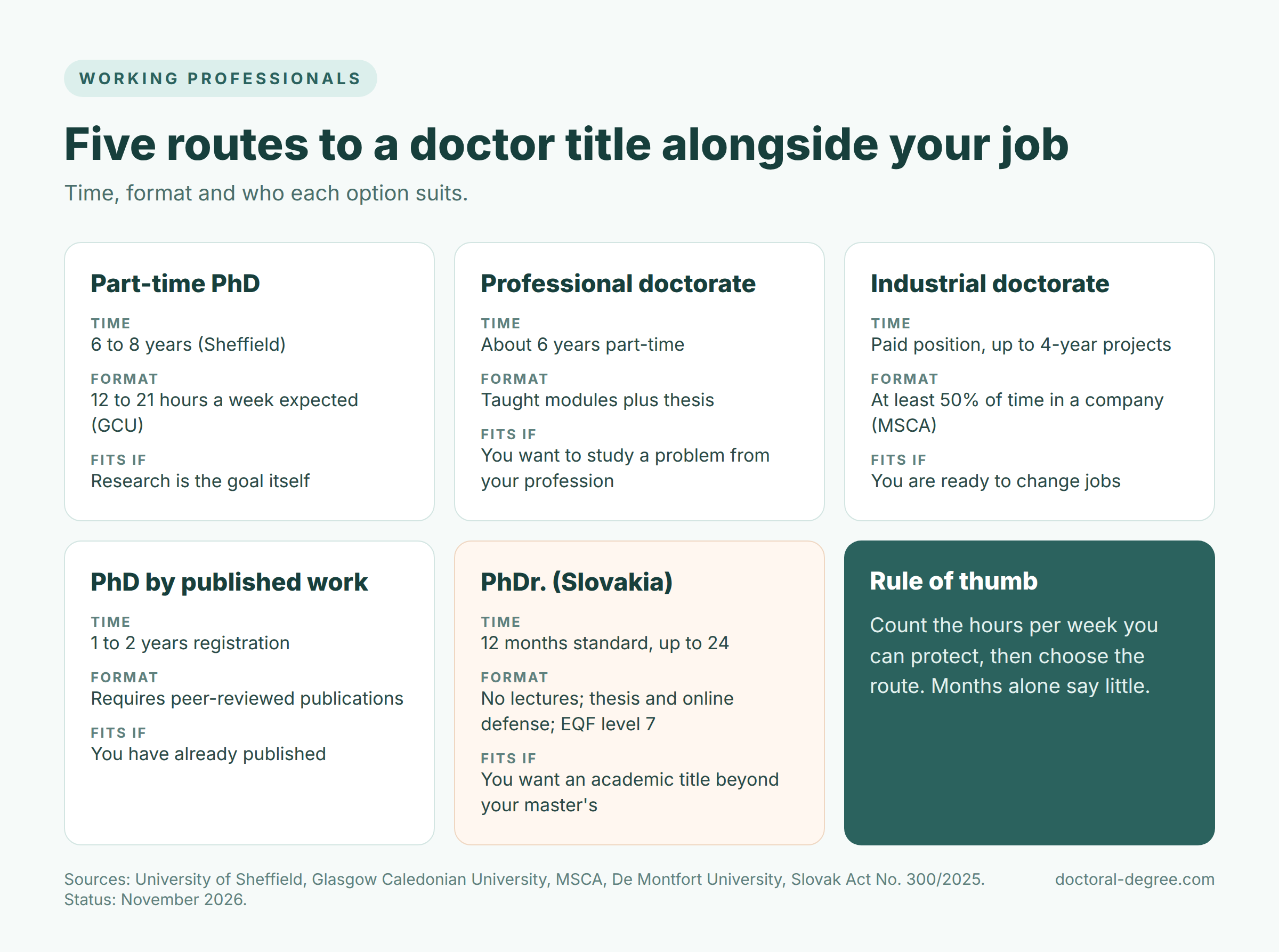
Universities that run part-time doctorates publish surprisingly concrete expectations. The Open University requires part-time research students to spend at least 18.5 hours a week on their studies (research degree regulations, Word document). Glasgow Caledonian University expects part-time PhD students to work on average at least twelve, but under twenty-one, hours a week (GCU research student handbook).
Put that next to a 40-hour job and you get a realistic picture: a part-time PhD is a second job for six years or more. Before you choose a program, decide honestly how many hours you can protect every week, including the weeks when work is busy.
Option 1: part-time PhD
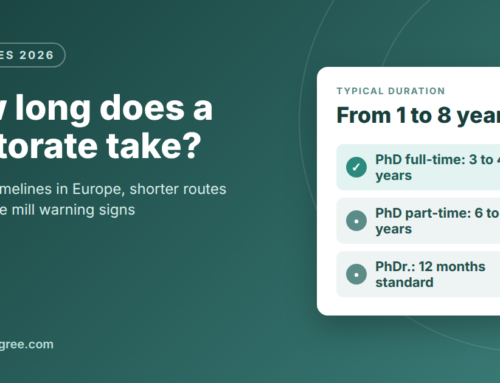
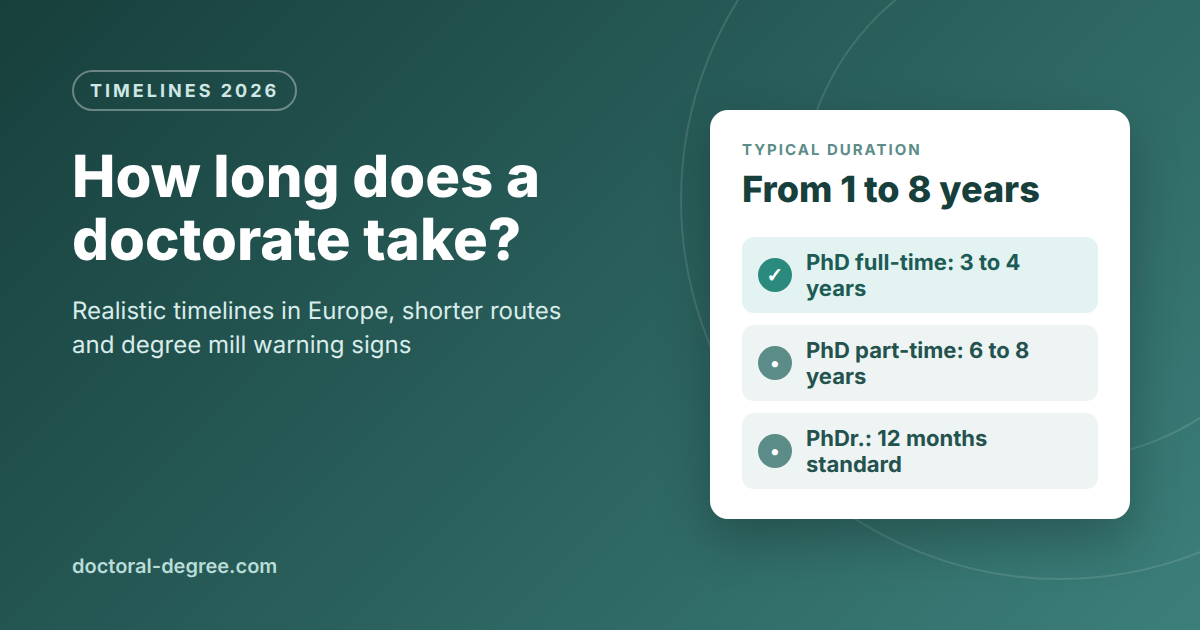
A part-time PhD leads to the same degree as a full-time one, with the timeline stretched. The University of Sheffield gives a normal period of six to eight years for a part-time PhD (registration periods). It suits you if research is the goal in itself or if you plan to move into academia later. It works best when your topic overlaps with your job, so that the hours spent on one also feed the other.
Option 2: professional doctorate
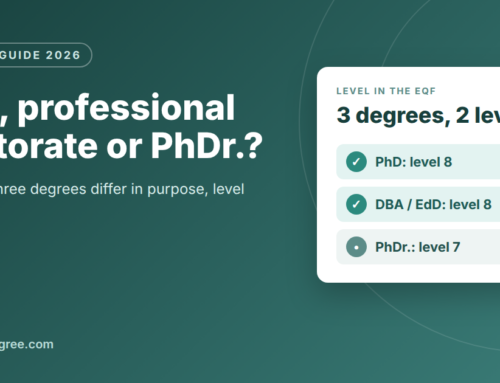
Professional doctorates such as the DBA or the EdD were built for practitioners. Research is usually linked to your own professional field and often carried out in your organization, and programs combine taught modules with a thesis, as the UK Quality Assurance Agency describes in its Doctoral Degree Characteristics Statement. Timelines are similar to a part-time PhD; Sheffield lists six years as normal for its part-time EdD.
Option 3: industrial doctorate
The EU’s Marie Skłodowska-Curie Actions fund Industrial Doctorates in which doctoral candidates are supervised jointly by a university and a company and spend at least half of their time in the non-academic sector (MSCA Doctoral Networks). This is a paid doctoral position rather than study alongside an existing job. It can be a strong option early in a career, but it usually means applying for a new position.
Option 4: PhD by published work
If you have already published peer-reviewed research, some UK universities award a PhD on that basis, with a critical commentary and an oral examination. Registration periods are short, often one to two years part-time. Without an existing publication record, this route is not open.
Option 5: the PhDr.
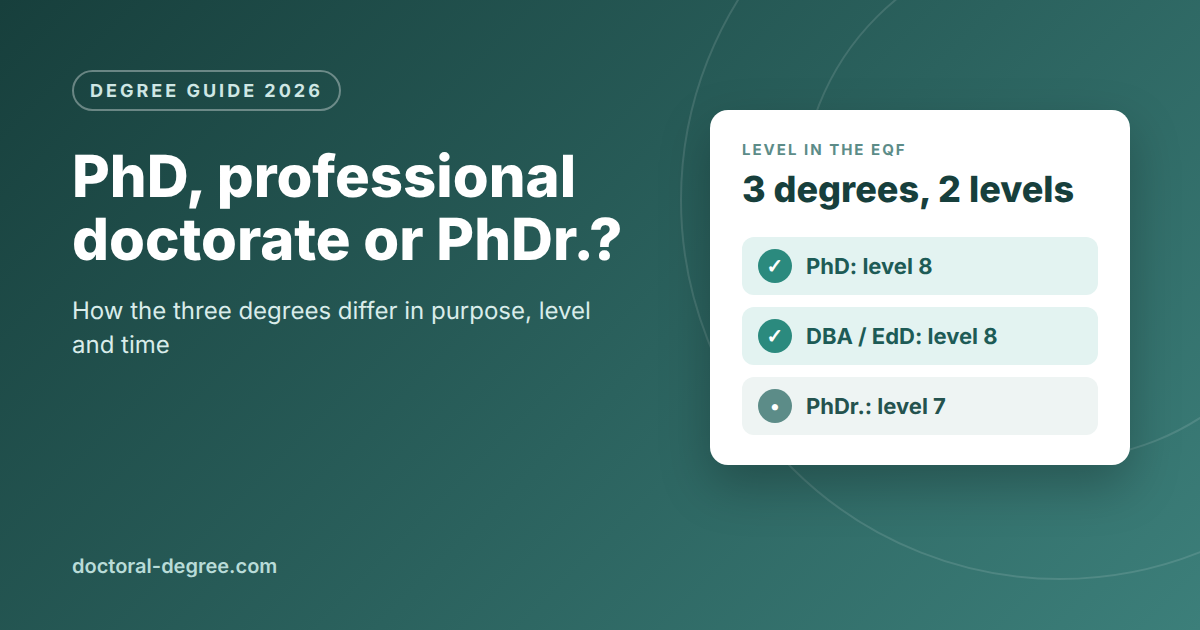
The Slovak PhDr. is an academic title for master’s graduates, awarded after a rigorous examination with the defense of a thesis (section 61 of Act No. 300/2025 Coll.). It is classified at master’s level, not as a PhD, which is why it takes less time. At DTI University there are no lectures: you write a thesis of 90 to 120 pages in English, receive supervision online and defend your work by video conference. The standard period is 12 months, with a free extension up to 24 months.
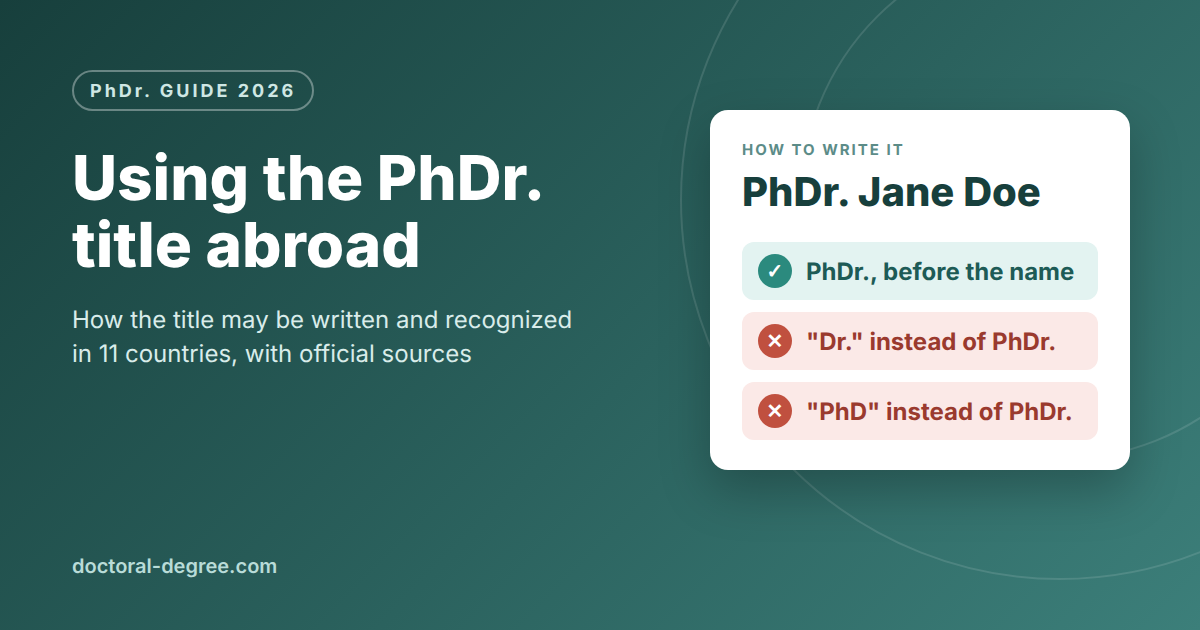
Because there are no fixed class times, the PhDr. fits irregular working weeks well. It still requires steady independent work. Many of our students write in fixed slots in the evenings or on weekends. What the title is worth in your country is explained in Using the PhDr. title abroad.
Talk to your employer early
- Topic and data. A topic from your daily work saves time, but company data may be confidential. In Slovakia, theses are registered centrally and as a rule made accessible to the public (Ministry of Education manual, PDF in Slovak). Agree in advance what you may use and in what form.
- Time. Ask whether you can bank overtime, take study days or reduce hours for the final months.
- Money. Some employers contribute to further education if the topic is relevant to the company. Ask before you sign up, not afterwards.
- Use of the title. If you work in a regulated field such as health care, check whether and how you may use an academic title in your work.
A simple way to decide
Write down three numbers: the hours per week you can protect, the number of years you are prepared to commit, and the budget you have. Then add one sentence about what the title should do for you. If the sentence mentions research or an academic career, look at a part-time PhD or a professional doctorate. If it is about documenting academic work beyond your master’s degree within a limited time, the PhDr. may fit. We are happy to go through it with you in a free consultation via the contact page.
Written by Oliver Scharfenberg, PhDr. MBA. Transparency note: this website is operated by Syntharis Group. Syntharis Group advises applicants, places them with DTI University and provides the translations needed for the procedure, so we have a commercial interest in the PhDr. program. Facts about other degrees are taken from the sources linked above.

Related Posts